What Is a Headless CMS and Do You Actually Need One?
In 2018, I sat in a converted warehouse while Skullcandy told a room of eCommerce developers that headless was going to change how we build for the web. I filed it under "buzzword" and figured it would be gone within two years.
Eight years later, it's back, this time attached to the content management system (CMS).
According to Google Trends, searches for "headless CMS" spiked in Q1 and Q3 of 2026, and the pitch has followed. Some version of "we should really go headless" is turning up in a lot of meetings.
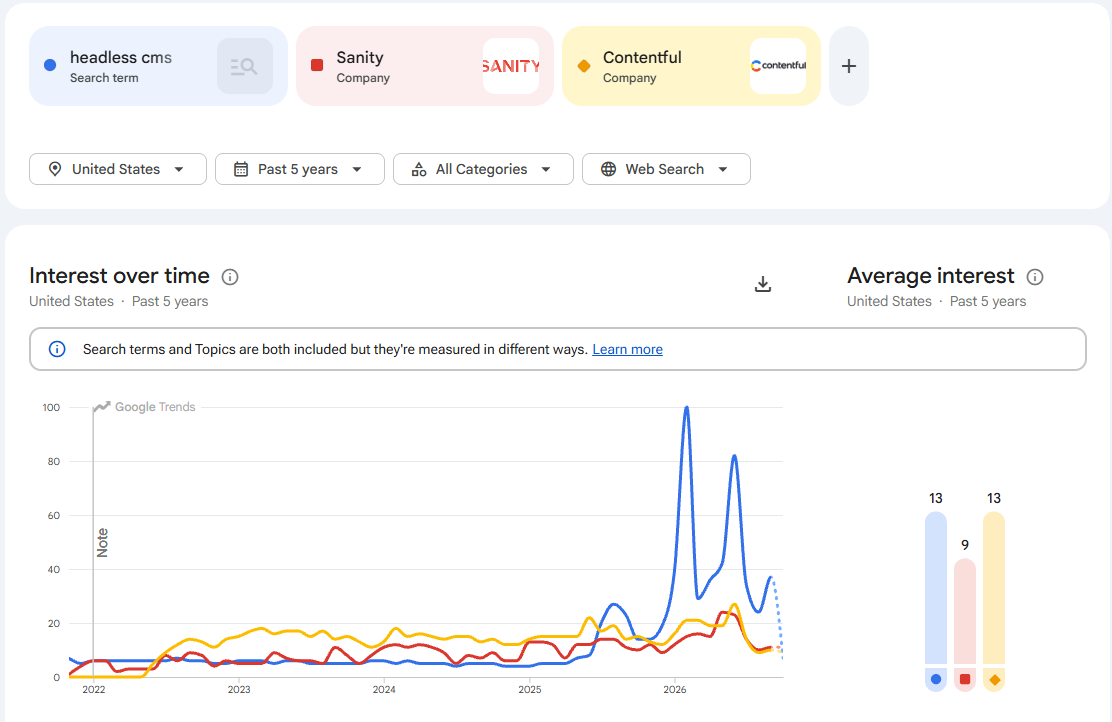
If you've been in one of those meetings and couldn't tell whether you were falling behind or about to be sold something expensive, that's a reasonable reaction. This piece is here to help you answer one question: does headless make sense for your organization right now?
What Headless Actually Means
Every website needs two things: a place to enter and store content, and a place to display it. That display layer is the "head": your website, your app or any other channel.
A traditional CMS like WordPress bundles the two together. A headless CMS separates them, storing content as structured data and serving it through an application programming interface (API) to as many heads as you need.
The idea isn't new. It started in commerce around 2013 and was common practice among front-end developers long before it reached the CMS conversation.
Why Everyone is Pitching It
Headless keeps coming back, and every time it does, someone is selling it.
Platform vendors pitch it because a migration means new licenses. Developers pitch it because modern frameworks are genuinely better to build with. Agencies pitch it because a rebuild is a bigger engagement than a tune-up.
None of that makes headless wrong. It means most of the advice you're hearing comes from people with a stake in your saying yes, and the costs tend to land on people who weren't in the room.
What isn’t in the Pitch
Headless is an architectural decision. Developers feel the benefits first: their choice of framework, faster sites and no more fighting a CMS's templates. Everyone else tends to feel the costs.
Your editors lose the page. We worked with a client whose marketing team wanted to make quick content updates to its main website, but that ability was never scoped with the development team. Every content change became a ticket, a QA pass and a scheduled deployment, when it should have been marketing logging in and hitting publish. In a headless build, page editing and live preview don't come for free; they have to be planned, built and maintained.
You're running two systems. The CMS and the front-end application each need their own hosting, deployment pipeline, updates and security. That usually means a SaaS subscription plus front-end hosting, and two teams who have to stay in sync.
Logic ends up in the wrong place. If business rules, like how search results filter or how a form validates, live in the website's templates, a second channel won't have them. Point a mobile app at the same CMS and you're rebuilding that logic, then maintaining it twice.
You can end up more dependent, not less. A custom front end, a middle layer only one team understands and a CMS subscription registered to someone else's account add up to exactly the lock-in we've written about in Client Independence Is Our Standard. Headless done right means standard tooling, real documentation and accounts the client owns from day one.
Each of these is solvable. None of them solves itself, and an unplanned headless build leaves you with a faster website that's slower to change.
Four Questions That Can Help You Decide
Whether headless is right is a business question, not a technology one. Four questions will get you most of the way there.
- Are you delivering content to more than one channel, or will you be soon? Multiple sites, an app, a storefront or devices beyond the browser are where headless earns its complexity. If everything goes to one website and will for the foreseeable future, it probably doesn't.
- Do you have the team to support it? Headless needs a capable front-end team, in-house or through a partner, for the life of the site, not just the build. If that isn't in place yet, get your content structure right first and plan the move later.
- How much do non-technical editors drive publishing? If marketing publishes daily and expects visual control, the editing experience will make or break the project. It has to be planned and budgeted from the start.
- Is your content a strategic asset or a maintenance task? Teams that treat content as infrastructure, feeding several channels and staying readable to AI systems (see What Is an AEO Audit and Why Do You Need One?), get the most from headless. If content is mostly a box to check, the overhead won't pay for itself.
If the first two answers are yes and you've planned for the third, headless deserves a serious look. If either of the first two is no, a well-built traditional CMS will likely serve you better, and there's nothing bad about that.
If the Answer is Yes, Start with the Content Model
Most teams want to jump straight to the platform: Sanity, Contentful, Storyblok, Strapi or headless WordPress. That choice matters less than you'd think.
What decides success is the content model: your content types, how they relate to each other and the metadata they carry. A well-architected model on a mid-tier platform will outperform a poorly architected one on the industry leader every time. Get the model right first, and the platform decision gets much easier.
So, Do You Actually Need One?
In 2018, I assumed headless was a fad. It wasn't, but it isn't the default answer it's sold as, either.
Headless pays off when you're delivering content across channels, have the team to support it and treat content as an asset. Short of that, it's an expensive way to solve problems you may not have.
If you're weighing the move, bring your answers to those four questions to a 30-minute conversation with our team. We'll tell you honestly whether headless fits, and if it doesn't, we'll tell you what will.